OpenAI has invested in Merge Labs, a startup developing brain-computer interfaces (BCIs). The company raised a total of $252 million in seed funding, according to Bloomberg. OpenAI CEO Sam Altman is a co-founder of Merge Labs. The exact size of OpenAI's investment remains unknown.
Merge Labs aims to combine biological and artificial intelligence to improve human capabilities. The startup is working on safer BCIs with higher bandwidth by combining biology, devices, and AI, according to OpenAI. OpenAI views BCIs as an important way for humans to interact more naturally with AI systems. The collaboration includes basic science models and tools to speed up research.
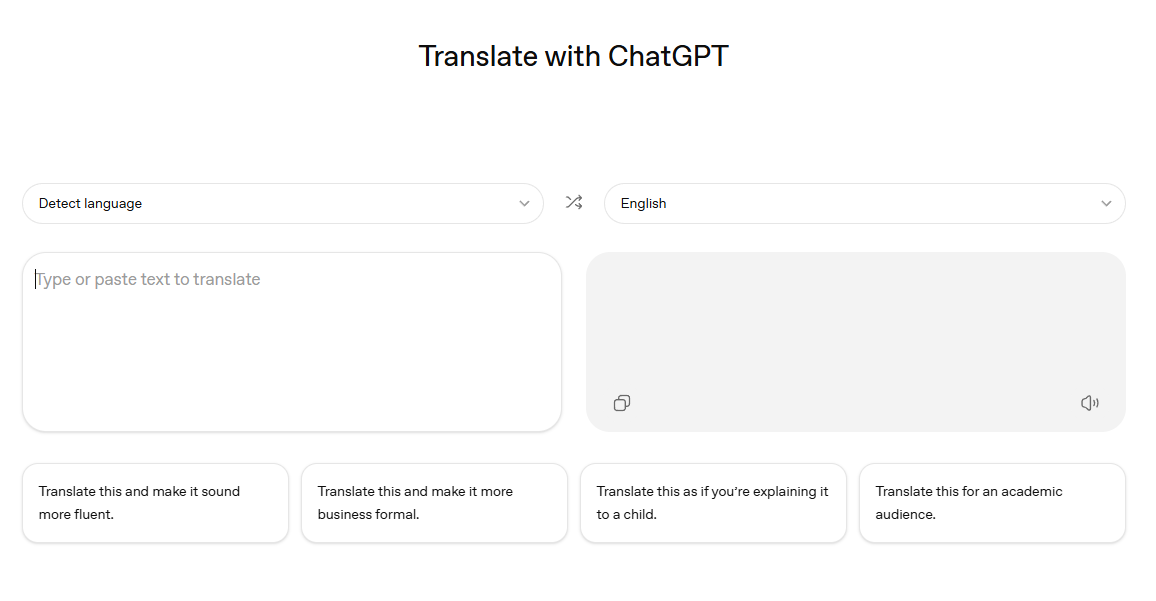
OpenAI has launched a standalone translation tool built on ChatGPT. "ChatGPT Translate" supports more than 25 languages with an interface similar to Google Translate or DeepL—two text fields with automatic language detection for the input.
OpenAI's ChatGPT Translate uses the familiar two-panel layout seen in other translation tools. | Screenshot: THE DECODER
Users can refine translations with additional prompts, for example, switching to a business tone or simplifying for children. These prompts redirect to the main ChatGPT interface, suggesting the tool is mainly designed as a gateway to the chatbot. OpenAI hasn't officially announced it yet.
Unlike full ChatGPT, the tool only handles text with apparent length limits. During testing, it sometimes returned chatbot responses asking for clarification instead of translations, with no way to respond. This suggests it's essentially a prompt in a new interface rather than a specialized translation model. For now, ChatGPT itself remains the more capable option.
The US AI industry continues to deliver drama. OpenAI has rehired three former employees from Mira Murati's AI startup Thinking Machines, including co-founder Barret Zoph, who was recently fired as CTO. Thinking Machines let Zoph go for "unethical conduct," according to journalist Kylie Robison, citing two sources.
A source speaking to Wired claims Zoph passed confidential company information to competitors. OpenAI, the company he's now returning to, would be the obvious candidate. OpenAI's product CEO Fidji Simo announced Zoph's return in an internal memo and on X, saying the company doesn't share Murati's concerns. According to Simo, his return had been "several weeks" in the making.
OpenAI has released GPT-5.2 Codex to developers through the Responses API. The model was previously limited to the Codex environment. According to OpenAI Developers, it excels at complex, tedious tasks like developing new features, refactoring code, and tracking down bugs. OpenAI also says it's their best cybersecurity model yet, helping identify vulnerabilities in codebases.
The model accepts text and images as input and offers four levels of reasoning effort: low, medium, high, and very high. Pricing comes in at $1.75 per million input tokens and $14 per million output tokens, a notable increase from earlier GPT-5 Codex models, which cost $1.25 per million input tokens and $10 per million output tokens.
Coding platforms Cursor and Windsurf have already integrated the model, with Windsurf offering it at half price for a limited time. OpenAI has published a prompting guide.
Actor Matthew McConaughey just got eight trademark applications approved by the US Patent and Trademark Office to protect himself against unauthorized AI copies. The trademarks cover a seven-second clip of him standing on a porch and audio of his famous line "Alright, alright, alright" from the 1993 film "Dazed and Confused," among others, according to the Wall Street Journal.
McConaughey says he wants to make sure his voice and likeness are only used with his permission. "We want to create a clear perimeter around ownership with consent and attribution the norm in an AI world," he writes in an email to the WSJ. His lawyers Jonathan Pollack and Kevin Yorn see the trademarks as a potential tool against AI abuse in federal court, though whether this strategy will hold up before a judge remains to be seen.
Anthropic is growing its Labs team, which builds experimental Claude AI products. Instagram co-founder Mike Krieger, formerly Anthropic's Chief Product Officer, is moving to Labs to work with Ben Mann. Ami Vora, who joined in late 2025, will lead product development alongside CTO Rahul Patil.
According to President Daniela Amodei, Labs gives Anthropic room to experiment. The team has already shipped several hits: Claude Code became a billion-dollar product in six months, and the Model Context Protocol (MCP) now sees 100 million monthly downloads as the industry standard for connecting AI with tools and data. Cowork, which brings Claude Code capabilities to office work, was built in Labs in just 1.5 weeks. Skills and Claude in Chrome also came out of the lab.